
Finding a Tucker County Property Owner
Begin with a street address in the WV Property Viewer. If E-911 cannot place it, search the street name in IAS. Or query by parcel attributes instead. The assessment report gives the owner name. It often adds a legal description plus a deed book and page reference. From there, check the Tucker County Clerk's land index for the most recent conveyance. Think of it as a chain. Place leads to parcel. Parcel leads to roll, and roll to deed. When an entity holds the land, the deed leads to an entity filing that names it.
- Find the parcel through the physical address, street name, owner name, or full parcel ID.
- Open the IAS report and note the Property Owner field, mailing address, legal description, and deed reference.
- Search the latest deed at the Tucker County Clerk and compare the grantee with the roll.
- If the grantee is an LLC or corporation, use the WV Secretary of State business search to inspect its filing.
- Use the public mailing address for a property-related letter; do not treat it as the situs.
Tucker County Owner Display Limits
The Viewer sometimes lists a single owner in a result row. Several people may still hold title. Open the parcel detail and the assessment report before trusting that brief line. IAS labels its owner field Property Owner. The report separates Physical Address, Mailing Address, Building Information, Cost Values, and Appraised Values in its layout.
The Tucker parcel assessment result view displays the report. It also shows the parcel-detail controls used to examine an owner name closely.
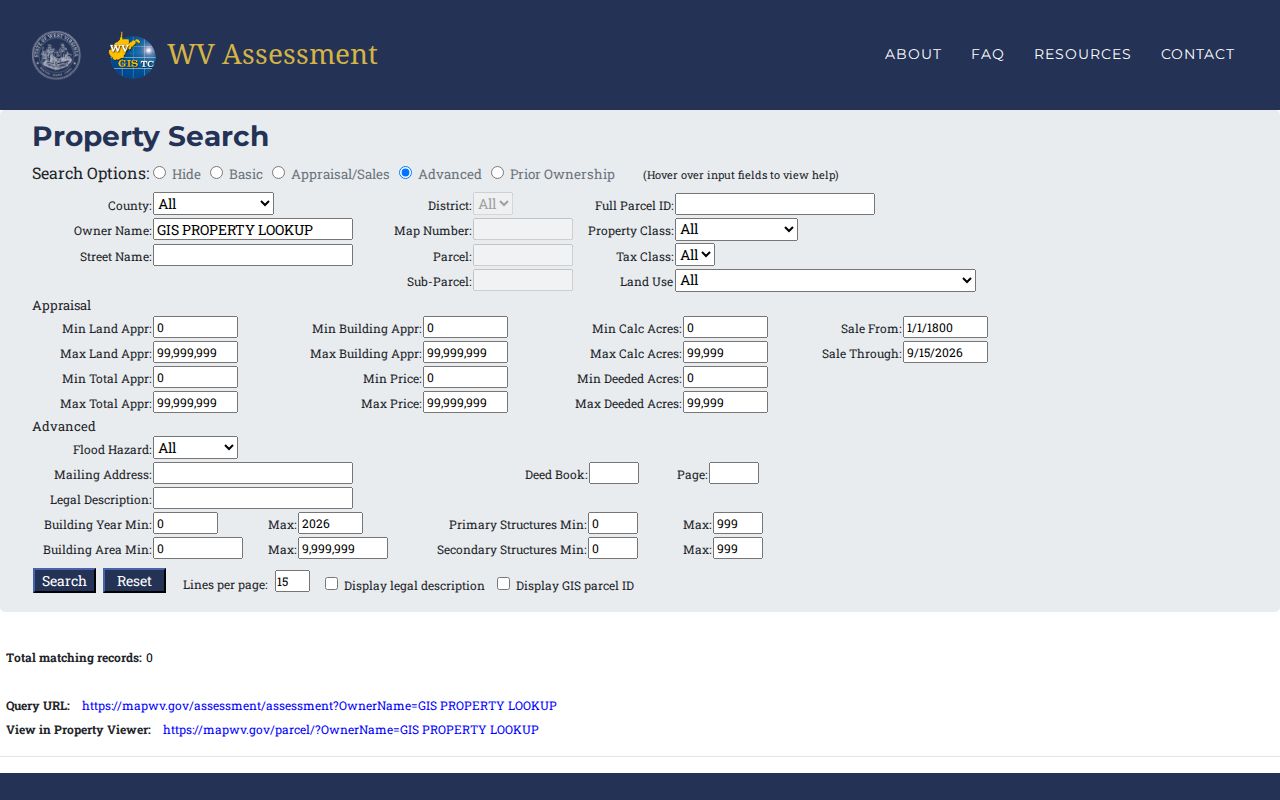
That screen shows one search result path, not a certified list of every person holding an ownership interest in the land.
Tucker County Situs and Mailing Names
A situs is the physical place tied to the parcel. The mailing address is simply where tax notices go. The two can differ, and neither one proves who occupies the land today. E-911 relies on physical address data and excludes rural routes and post office boxes. When the exact address is unknown, try a street name. Searching it in IAS often works better than guessing a number. A distant mailing address should never be mistaken for the property's location.
Keep several facts handy for a Tucker County owner lookup. These include the parcel's community, E-911 address, physical address, and legal description. Postal labels for Parsons, Thomas, and Davis can reach rural places beyond municipal boundaries. A parcel's community layer gives a better location check. Its deed description does too. Together they give better location checks than a town name on an envelope.
Where Tucker County Owner Names Appear
Each Tucker County source captures a different slice of ownership. IAS and the WV Property Viewer tie an owner to the assessment parcel. The County Clerk's deed index records the grantee on each instrument. The Circuit Clerk may hold a case that disputes or changes an interest. The Secretary of State helps identify an entity named in a deed, though a filing alone does not prove that entity owns a specific tract.
| Source | Owner Info It Gives | Access |
|---|---|---|
| IAS assessment roll | Property Owner field, parcel, legal description, mailing and physical addresses | Free statewide search |
| Tucker County Clerk | Grantee on a recorded land instrument | Land-record landing page; ask clerk about index access |
| WV Property Viewer | Mapped parcel, owner display, community, and assessment link | Free public map |
| WV Secretary of State | Business organization filing, agent, or office details where shown | State business search |
These sources name an owner of record, not necessarily a person living at the property. A public parcel record establishes neither occupancy nor a full title opinion. For the present-day owner record and its refresh limits, see the separate Tucker County current-owner record detail.
Update schedules differ too. IAS is an assessment record. A recorded instrument enters the Clerk's land books at filing. The county publishes no fixed number of days from closing to an assessment-owner update. A new deed can therefore be the freshest ownership clue. The tax roll may still show the prior owner. Keep the recording date distinct from the date signed or the date a sale closed.
The Tucker Clerk's online land-record landing page lists the instrument types it handles. It says nothing about searchable fields, an online start year, image coverage, or copy fees. An owner-name query may return no deed. Ask the office which index route or courthouse record can settle it. A missing result on the public landing page does not mean no deed was ever recorded.
Tucker County LLC and Estate Owners
A deed can name a business, trust, executor, administrator, or estate rather than a person. The county roll may carry the old owner name while probate work is still pending. Tucker County Clerk probate duties cover wills, estate administration, guardianships, and notices to heirs. They also cover deeds tied to delinquent property. When someone has died, read the probate file and the recorded transfer together. A death certificate alone never moves land.
The WV Secretary of State's Business Organization Search can look up an organization name. It also pulls up related filings. It may reveal a registered agent or principal office. But the deed is what links the entity to the parcel. Search the exact entity spelling from the newest deed. Then return to the legal description. Confirm both records describe the same land.
Recent Tucker County Transfers
A deed can reach the County Clerk long before the assessor's roll reflects the sale. Tucker County runs its assessment work on an annual cycle. Each December 1, the assessor reports prior-year transfers to the Tax Commissioner. New construction over $1,000 goes in that report too. The county gives no fixed number of days between recording and a roll update. So check the clerk's recording date against the latest assessment report. Ask the Assessor's office when its next update lands.
Bring the right details to that comparison. You want deed book and page, grantor, grantee, recording date, and the legal description. Suppose the assessment owner and the newest deed disagree. Don't pick one by guesswork. The deed's record date is the fresher source for a recently filed transfer. The roll still earns its keep for the parcel's appraisal and its mailing field.
Tucker County Owner Privacy
West Virginia tax law draws a clear line. Tax returns and return information stay confidential. Property descriptions, assessments, and appraised values remain public. Certain security-system details and other protected information stay withheld. Voter records exclude sensitive identifiers like Social Security numbers, driver or state ID numbers, phone numbers, and email addresses. Never use one public field to guess at a protected person's location.
Tucker County publishes no official property-fraud-alert signup. No Safe at Home program URL is listed. Ask the County Clerk whether any recording alert service exists. Privacy questions go to the records custodian or the state program. A public owner lookup serves property, title, tax, historical, and civic research. It is not for unwanted contact with anyone.
Treat the mailing field as a tax-correspondence destination. It is not a phone directory. It does not prove a named person lives at the property. Some owners list a post office box, an agent, a trust, or a business address. When you need to verify a transaction, request the recorded instrument by its book and page or by party names. Do not read a map result as personal contact information.
Limits of a Tucker County Owner Lookup
A Tucker County owner lookup only reaches what the public records hold. It cannot reveal every private fact about a person. It cannot prove who occupies a building. It cannot guarantee the assessor roll is current, and it never replaces a title search. The listed owner may be a company or an estate. The map may show just one name. When title to a specific tract is the real question, rely on the recorded deed and the legal description.
Lawful use. Tucker County ownership records support property due diligence, tax review, and civic research. Do not use a name or mailing address to stalk, threaten, or harass anyone.