
Tucker County Property Tax Record Fields
A Tucker County property tax record is really two records joined together. The assessor contributes the property roll. It covers appraised value, assessed value, classification, parcel description, and any exemptions. The sheriff adds the collection side, gathering county, municipal, school, and state taxes. Delinquent land and tax-sale steps appear in State Auditor listings instead. Each source answers a different question. An appraisal field on the public roll is not a balance due. Read the numbers with care.
| Field | What It Shows | Where |
|---|---|---|
| Appraised value | Assessor's annual estimate of market value | Tucker County Assessor / IAS |
| Assessed value | Taxable value at the state assessment level | Tucker County Assessor |
| Property class | Owner-occupied, farm, or other real/personal category | Assessor roll |
| Homestead exemption | Qualifying reduction in assessed value | Assessor; statutory claim process |
| Tax bill and payment | Amount due and payment or delinquency status | Tucker County Sheriff |
| Delinquent-land sale | Notice, sale, redemption, or later process | State Auditor and Sheriff |
Values come in layers. Appraised value is the assessor's market estimate; assessed value is the slice actually taxed. The levy rate then multiplies against that assessed figure. A sale price proves a transaction happened, nothing more. For a parcel-level lookup, match the tax source to district, map, parcel, and legal description rather than trusting a street address alone.
Tucker County Value and Tax Math
Tucker County real estate is appraised annually at market value. The math is simple once you see the order. Appraised value is multiplied by 60 percent to yield assessed value. The tax itself is assessed value times the levy rate. That sequence matters. The appraised figure is not the taxable one. The assessed figure alone still does not tell you what the owner owes.
The assessor also maintains tax maps and property records. The office completes sales-ratio work. It updates land values each year. It also physically visits real estate at least once every three years. Property books go to the Board of Equalization and Review by February 1. Assessed values are certified by March 3. The Tucker County Assessor's duties and schedule gives the local description.
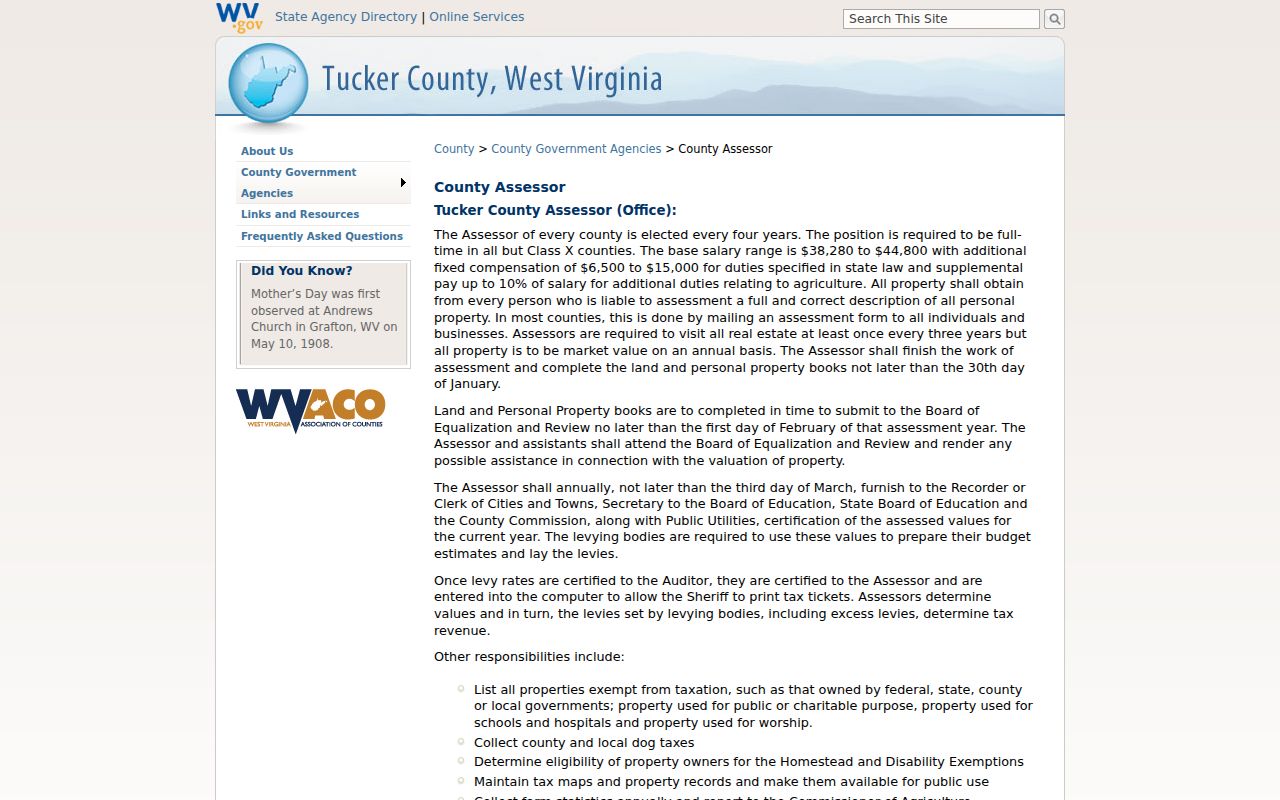
The assessor's own pages describe the mapping and assessment work behind every value field in the county roll.
Tucker County Tax Class Differences
Classification decides how a Tucker County parcel enters the tax system. Class II covers owner-occupied homes and farms. Classes III and IV cover other real and personal property, outside and inside municipalities. This includes rentals or vacant land the owner does not occupy. The assessor's class and tax-class fields show which levy context applies. They still will not state a full tax bill by themselves.
Location matters because Class IV means property inside a municipality. A mailing ZIP proves nothing about town limits. A parcel may sit near an edge. Then compare the assessor's community field with the GIS boundary or an official annexation exhibit. The legal description and tax district are better keys. Trust those over the postal city on an envelope.
Looking Up a Tucker County Tax Bill
Tucker County publishes no dedicated online tax-ticket search. The sheriff serves as county treasurer and tax collector. The office keeps the tax records and answers collection questions. Start with the parcel ID and owner name from IAS. Then call or visit the sheriff's tax office. Ask about the current bill, payment status, or a receipt. Delinquent land runs through the separate Auditor route. Status should be verified locally before anyone acts.
- Find the parcel in IAS and note the full parcel ID, owner name, and property class.
- Contact the Tucker County Sheriff with that ID and ask for the bill year and payment status.
- Compare any exemption on the bill with the assessor's roll and claim record.
- For delinquency or a tax sale, check the State Auditor's list and confirm redemption or payment with the Sheriff.
- Assessed value
- The value used as the base for the tax calculation.
- Levy rate
- The rate applied to assessed value by the taxing bodies.
- Homestead exemption
- A statutory reduction for a qualifying home owned and occupied by an eligible resident.
- Tax lien
- A claim tied to unpaid tax that may lead to statutory collection or sale steps.
Tucker County Sheriff Tax Records
The Tucker County Sheriff sits at 215 First Street in Parsons and answers at 304-478-2321. The office acts as treasurer. It collects state, county, municipal, and school taxes, maintains tax records, and enforces delinquent taxes. No searchable county tax-bill portal exists. A direct call or counter request is the route for a bill and payment status.
Collection records build on the assessor's values and levy information. But they answer a different question: whether a bill was paid or has gone delinquent. Ask for the tax year, amount, date paid, remaining balance. Also ask about any redemption status on the parcel. Treat a land-record lien or Auditor notice as its own separate document trail.
The Tucker County Sheriff page describes the tax-collector role and local contact.
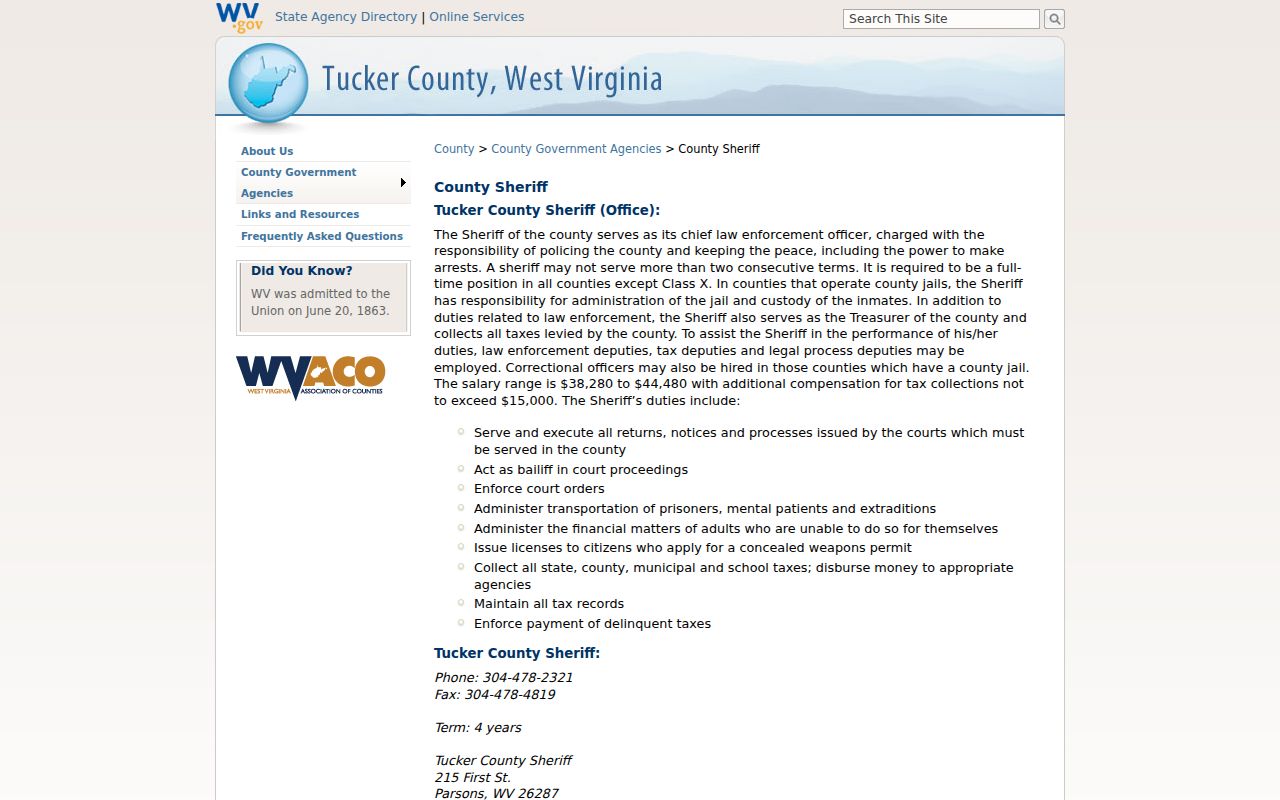
The sheriff's office is the local collection desk to call when the public web tools show no tax ticket.
Homestead Relief in Tucker County
West Virginia's homestead exemption knocks the first $20,000 of assessed value off a qualifying home. The owner must occupy the property as a residence. Eligibility also turns on age or disability. An owner qualifies at 65, or with a permanent and total disability, after meeting the statute's two-consecutive-calendar-year residency rule in West Virginia and filing the required affidavit. The claim goes to the county assessor by December 1, following the July 1 assessment day. A qualified senior or disability claimant generally does not refile unless moving, and disability claims need an accepted form of proof.
The exemption lowers taxable assessed value only. Market value and any recorded sale price stay untouched. It never applies by assumption, so check the assessor record and the claim status before counting on it. The governing law sits in W. Va. Code §11-6B-3, and §11-6B-4 carries the filing rule. Contact the Tucker Assessor for a current claim form and instructions.
Tucker County Tax Sale Checks
The State Auditor runs the county-collections tools that publish delinquent-land and sheriff tax-sale information. The process can move from a delinquent list through notices. Sheriff and Auditor certification comes next. A tax-lien sale, a redemption period, and a later deed or land-commission step may follow. A parcel can still be redeemed before sale. An old notice, standing alone, says nothing about present availability. Check the current record. Ask the local Sheriff about the sale date, payment, and redemption.
Auditor surface parcel files are built from county GIS and IAS attributes. They can exclude county court splits and mineral interests. Surface files are no substitute for deed records. Before relying on a sale result, compare owner, map number, parcel ID, legal description, liens, and any later recorded instruments. Mismatches here matter more than the sale notice itself. Confirm the live terms instead of trusting a cached notice. The Auditor warns that payment close to sale may require certified forms of payment.
The West Virginia State Auditor county collections portal is the official starting point. It carries the statewide list.
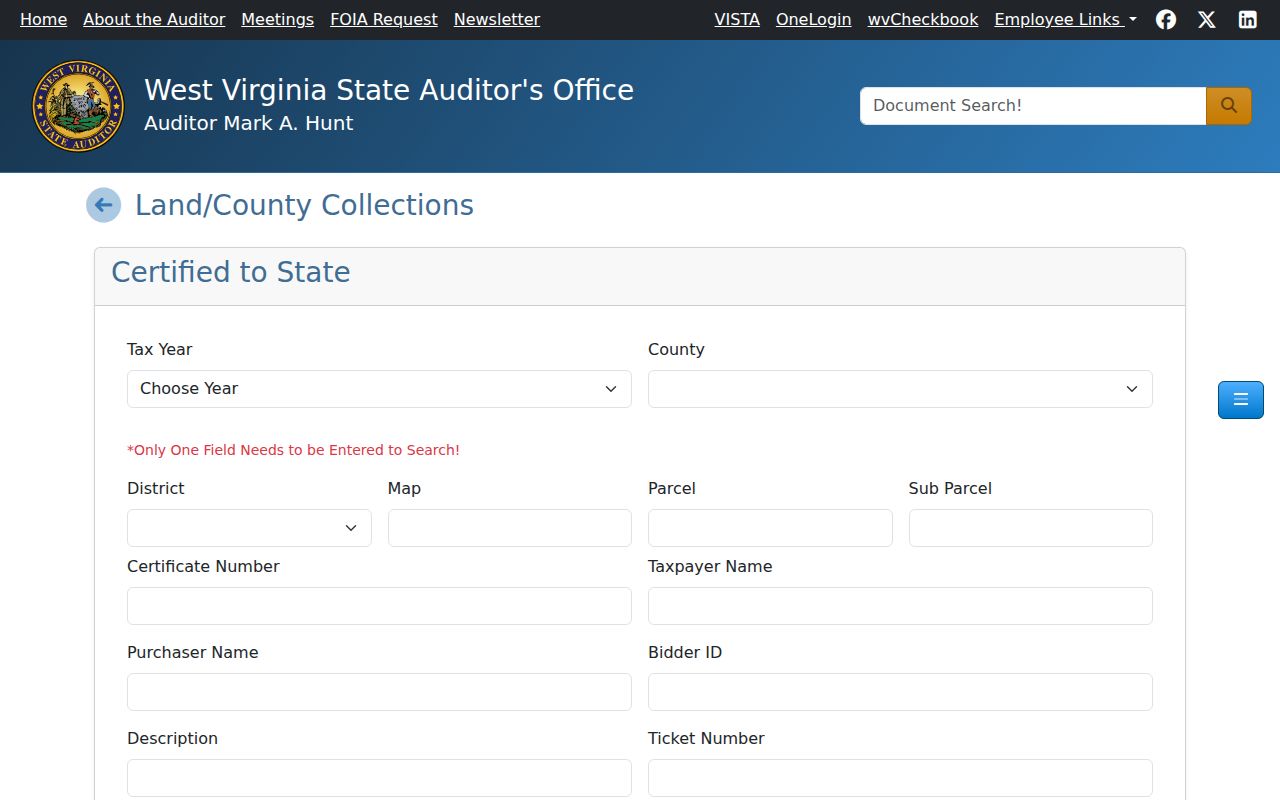
That tax-year selector is the Auditor's, not the county's, and it drives the delinquent-land route rather than current bills.
Tucker County Tax Record Privacy
West Virginia law shields tax returns and return information. The itemized property description, its assessment, and its appraised value remain public record. The assessor must withhold protected details. Security-system details and some personal property data qualify. A public assessment search is therefore not a view into every financial or personal item the owner supplied to the tax office.
Identify the parcel and the public field needed. The West Virginia Freedom of Information Act then sends the request to the custodian and allows charging only actual reproduction costs. For the legal lines, see W. Va. Code §11-1A-23 on tax information and §29B-1-3 on public-record requests.
Appealing a Tucker County Assessment
A wrong value, class, or exemption starts with the Tucker Assessor. The county commission sits as the Board of Equalization and Review no later than February 1. The Assessor certifies values by March 3. Real-property protests get a February 20 filing date. West Virginia Code §11-3-23a sets that deadline. It applies with the Board or the Office of Tax Appeals. A case proceeding from the Board to the Office of Tax Appeals then faces a March 31 petition deadline under §11-3-25b. Check the statute and the current notice. Keep your evidence in one file. Gather comparable sales, parcel details, and the exact issue being challenged.
A denied homestead exemption takes a separate route from a valuation protest. Article 6B requires an appeal to the county commission within 30 days after written notice. The commission must issue its determination by February 28 of the first application year. Further review may go to circuit court. Ask the Assessor first if a claim or notice has gone missing. The homestead statute sets the governing procedure.
Separate routes. A valuation protest generally follows the February 20 procedure in §11-3-23a; a homestead-denial appeal is due within 30 days after written notice. Verify the applicable route with the Assessor.