
Tracing Former Tucker County Owners
A backward chain table keeps the work honest, one conveyance per row. The public land-record page shows no sample deed results. So no actual party names or parcel transfers appear here. Copy each grantor, grantee, book, page, and date from the record itself. Keep the index entry beside the full instrument. A blank field belongs to the County Clerk or the historical catalog, never to guesswork. Assumption is how chains break.
| Transfer Date | Grantor → Grantee | Deed Type | Book / Page |
|---|---|---|---|
| Enter the deed's recorded date | Copy both names exactly as filed | Use the clerk's instrument label | Keep the full clerk reference |
| Repeat for each earlier transfer | The latest grantee may be the next grantor | Read the instrument itself | Record each source volume and page |
Start from the modern owner of record. The assessment report may give book and page. The current land-record index can help with recent instruments, but its online start year and image coverage go unstated. Historical catalogs identify older deed books and an index. A plat or local history can explain an old place name, but only a recorded conveyance proves each transfer.
Tucker County Index Coverage Limits
The Tucker County land-record portal lists document types and little else. It publishes no searchable years, no grantor or grantee fields, and no image cutoff. Fee rules are absent too. FamilySearch catalog entries offer historical leads, not proof the modern index reaches those years. Older volumes live somewhere specific. Call the County Clerk at 304-478-2414 ext. 201 or visit the courthouse. Ask where a volume is held and how to request a copy.
Tag each former owner by source. Note the source of the answer. Was it the online index, a physical deed book, or cataloged film? That habit keeps a gap visible. A missing online name proves nothing. Tucker County records are not fully digitized. An absent name never means the deed never existed. Ask the clerk whether a name index, a book and page reference, or a manual search exists. Any of these can carry the chain one link farther.
Historical Tucker County Deed Years
The cataloged years are concrete. FamilySearch lists Tucker County deeds from 1856 through 1902, plus a deed index spanning 1856 to 1970. An entry book runs 1857 to 1860. Land books cover 1856 to 1900, trust deeds 1889 to 1901, and miscellaneous volumes 1874 to 1902. Those years mark cataloged film, not the online cutoff.
| Deeds | 1856-1902 in catalog evidence |
|---|---|
| Index to deeds | 1856-1970 in catalog evidence |
| Entry book | 1857-1860 |
| Land books | 1856-1900 |
| Trust deeds | 1889-1901 |
The Tucker County FamilySearch catalog lists each volume. Viewing limits there may require an account or local access, and the County Clerk stays the official custodian of the deeds themselves.
Tucker County Book and Plat Clues
Old Tucker County deeds carry rich clues. An acreage, district, survey, stream, old road, or adjoining owner can anchor the parcel. The clerk portal lists plat maps. Its landing page shows no sample book and page or indexed subdivision roster. Keep every clue while moving from grantor to grantee. Ask the clerk for the plat name, map number, date filed, book and page, revision history, and whether the index uses a developer or surveyor name.
A legal description can survive a street renumbering or a shift in local place names. Compare lot, tract, road, district, acreage, and adjoining owner across each conveyance. Older descriptions may not show clearly on the current map. The deed remains the source for each transfer.
Walking a Tucker County Chain Backward
Start with the newest deed. Its vesting clause names the parties. The grantor conveys, and the grantee receives. Treat each grantee as the earlier grantor, and hunt for that person's own deed into the parcel. Tucker County publishes no index fields or cutoff online, so keep every book and page reference close at hand. Confirm the clerk's current index method before stepping back into older volumes.
- Locate the current parcel and the newest deed reference in IAS when one appears.
- Read the instrument's date, grantor, grantee, legal description, and marginal notes.
- Search the prior grantor as a grantee to locate the earlier deed into the same land.
- Repeat, testing name variants and corporate or estate names as the chain changes.
- Move to a deed book or cataloged historical volume when the online reach is not clear.
- Grantor / grantee
- The person or entity conveying / receiving the interest.
- Chain of title
- The ordered set of instruments that link successive owners.
- Legal description
- The written land identity used to match deeds across changing addresses.
St George to Parsons Records
The county-seat fight of 1893 is a working clue for former-owner research. Records moved from St. George to Parsons. The West Virginia Encyclopedia dates the move to the night of August 1. A WVU archival collection holds photographs of the move taken on August 2. No source claims a courthouse fire or destroyed deed books. Search both names for that period. The move is not proof of a gap.
The County Clerk sits in Parsons now. Land instruments and probate records are held there. Older deed books begin with the county's 1856 formation, and earlier ownership may require Randolph County records or earlier Virginia and federal land sources. The West Virginia Archives Tucker bibliography can help interpret a family or community name before the next deed search.
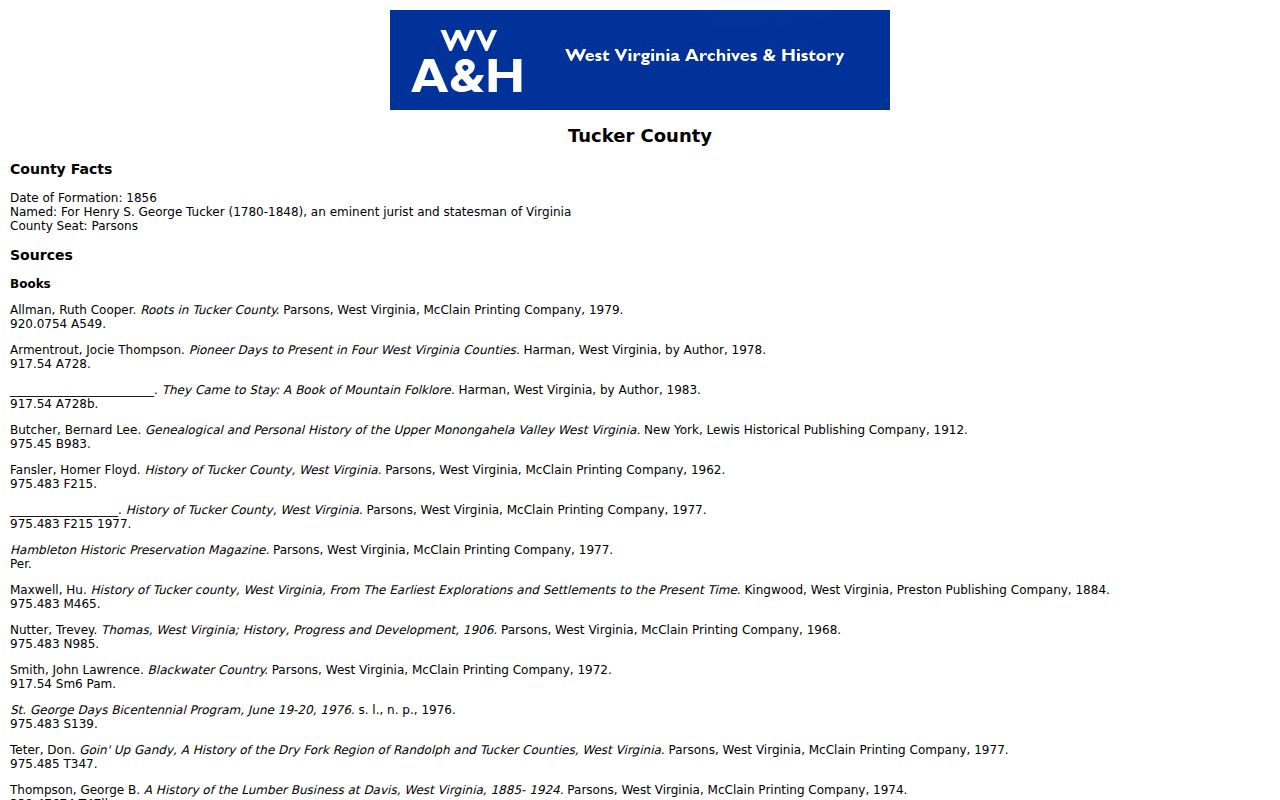
The archive finding aid points to county histories and newspaper references. Those sources decode names without serving as title evidence.
Company Names in Tucker County Deeds
Older land descriptions around Davis, Thomas, and Parsons followed the railroad and timber industries. A deed search from that era may cite a company, rail, timber, coal, district, or lot name. That can appear where a modern searcher would expect a street. Thomas deeds often place corporate and railway names ahead of private conveyances. Later commercial reuse adds another layer. A single chain can shift between corporate and personal grantors. For that reason, search the name printed on the instrument itself. Do not rely on the current town label.
The Five Rivers Public Library keeps Parsons Advocate microfilm and CDs. It also holds yearbooks and Tucker genealogy resources. Newspaper items can tie a business name to a street, a family, or a building. That context enriches a deed sequence. It does not replace the legal transfer itself. Obituary requests through the library require a date of death. That helps separate people who shared a name. Its local-history holdings are described in detail online.
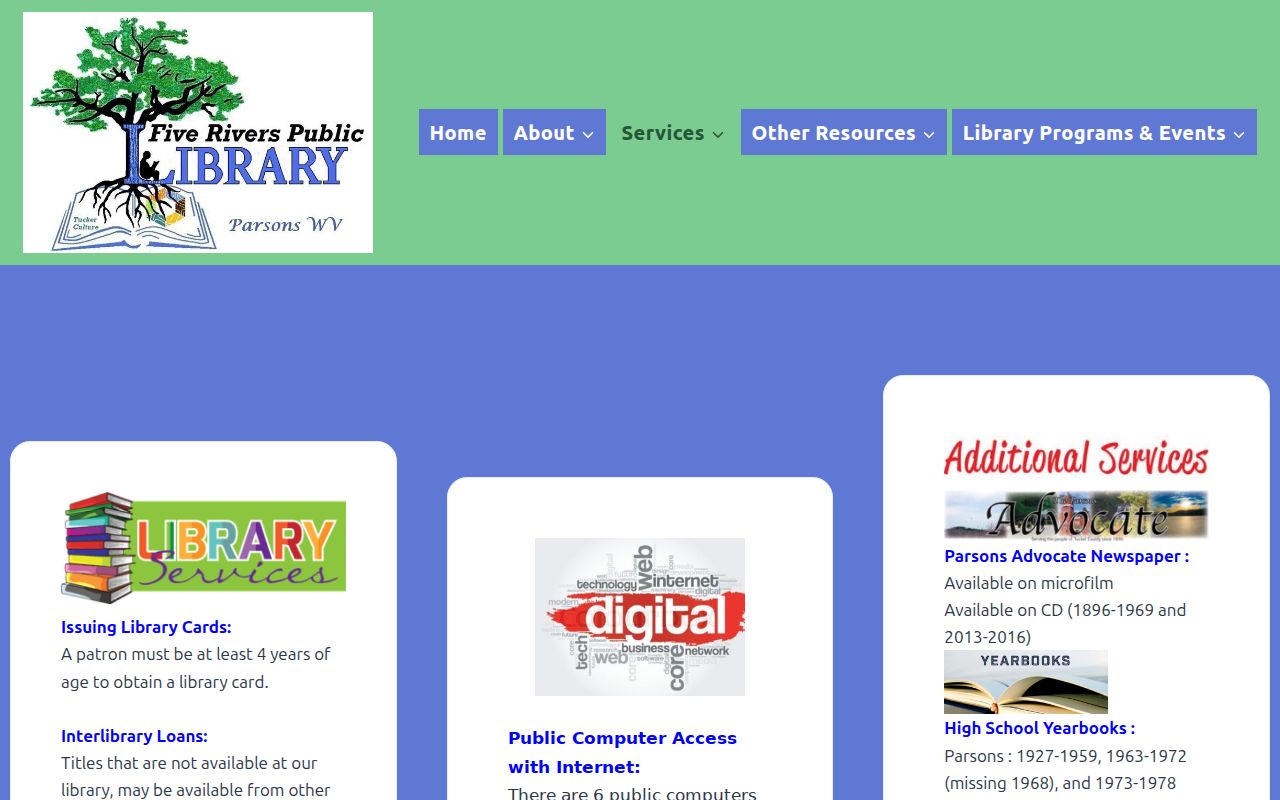
The library source adds newspaper and family context for names that surface in an older Tucker County deed chain.
Probate Links Between Owners
A clean deed chain can branch straight through an estate. After a prior owner, you may find a will, a fiduciary appointment, a deed from an executor or administrator, an affidavit of heirship, a partition, or a court order. The Tucker County Clerk handles probate and estate administration as well as recorded instruments. Search both sides together. Whenever a grantee dies before the next transfer appears, pull the probate file alongside the deed index.
A death certificate proves a death occurred. It transfers no land. Recent certificates carry eligibility and ID rules, while records more than 50 years old are generally public under West Virginia law. Before adding anyone to a former-owner timeline, track the fiduciary or heir instrument, its legal description, and the date it entered the clerk's record.
How Far Tucker County Ownership Reaches
The cataloged Tucker County deed books begin in 1856, the year the county formed from Randolph County. The county publishes no start year for the modern online index, and no courthouse fire or record-destruction gap is documented. For an earlier chain, ask whether Randolph County, Virginia, or federal land records hold the next reference, and preserve the survey or district description exactly as written.
Lawful use. Former-owner research in Tucker County is for house history, title work, estate matters, and property diligence. Do not use a chain of names to track, threaten, or harass a living person.